
_
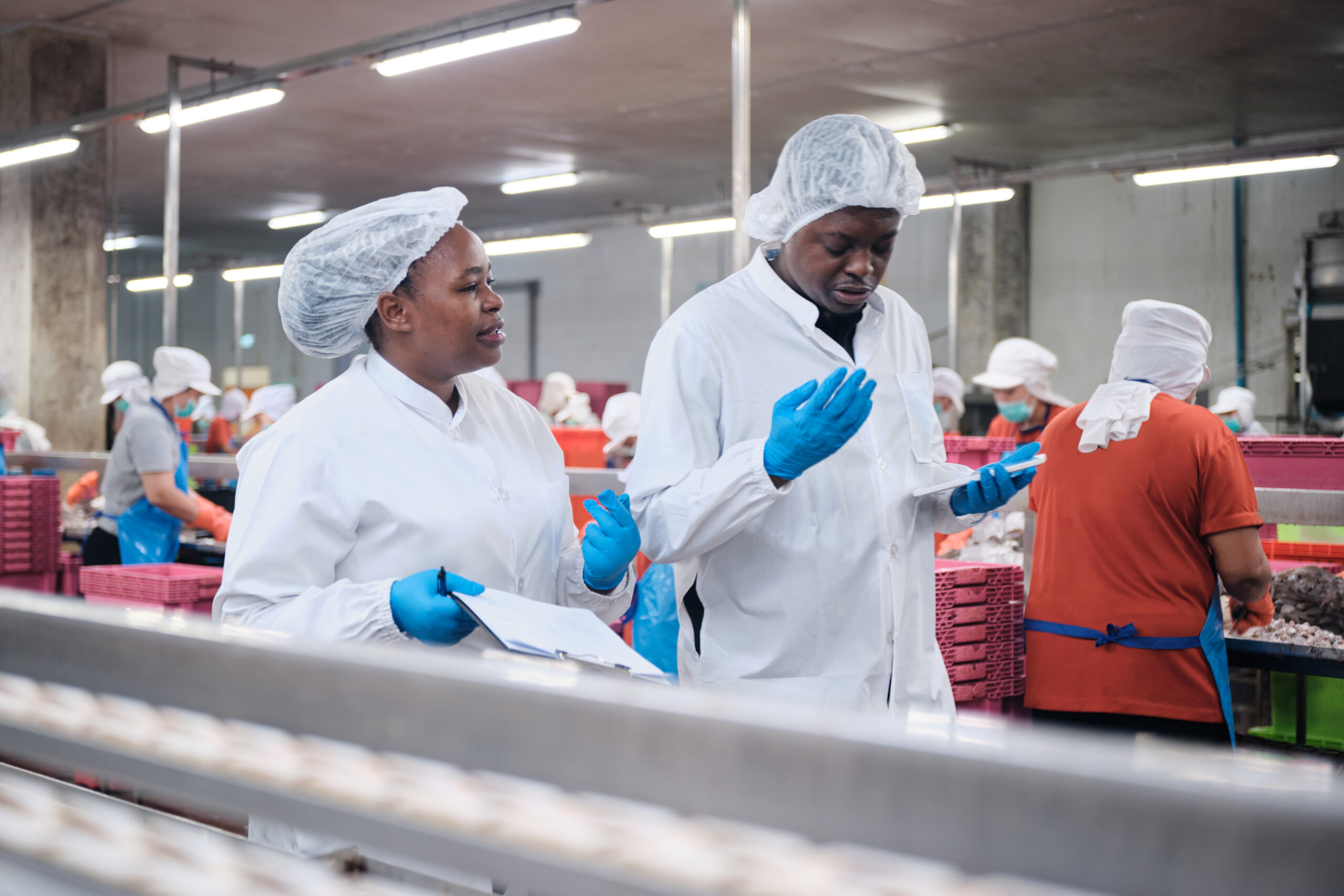
The food industry has two parties that must be protected at the same time:
- The worker, who faces daily hazards such as high heat in ovens and fryers, severe cold in freezers, cleaning and sanitizing chemicals, knives and slicers, and rotating machinery.
- The consumer, who must receive food that is safe and free from microorganisms, foreign bodies, chemical contaminants and allergens.
A glove in this field therefore has two jobs: it protects the worker’s hand from harm, and it acts as a barrier that stops contamination passing from the hand to the food. A glove that does only one of these jobs is an incomplete choice.
1. Protecting Both Parties
a- Worker protection
- Protection from burns and frostbite.
- Protection from cuts, abrasions and punctures.
- Protection from contact dermatitis caused by detergents, disinfectants and constant moisture.
- Reducing the risk of mechanical injuries such as pulling-in, crushing and entanglement.
b- Consumer protection
- Preventing bacteria and viruses (e.g. Salmonella, norovirus, hepatitis A) from transferring from hands to food.
- Preventing cross-contamination between raw and cooked foods, and between products with and without allergens.
- Making sure the glove material itself is safe and does not release harmful substances into food.
- Making lost glove fragments easy to detect: food-industry gloves are usually blue, a colour not naturally found in food, and are sometimes metal-detectable.
c- When the two goals conflict
A thick, cut-resistant glove may be hard to clean and may absorb liquids, so it is not ideal for direct contact with food. The usual solution is to wear a single-use food-grade glove over the protective glove, or to use a glove with a coating suitable for food contact.
2. A Key Principle: Gloves Are the Last Line of Defence
In the hierarchy of controls, gloves come after elimination, substitution, engineering controls (guards, barriers, lock-out/tag-out during maintenance) and administrative controls (training, procedures). Gloves reduce injury but never replace machine guarding.
3. Glove Types by Hazard
a- Heat
Where: ovens, bakeries, fryers, blanching, steam sterilization, handling hot trays.
Common materials: aramid fibres (e.g. Kevlar, Nomex), wool or cotton with an insulating layer, silicone for hot surfaces and steam, heat-resistant leather. A nitrile or PVC layer may be added against hot oils.
Standard: EN 407 (protection against thermal risks). Performance is rated for burning behaviour, contact heat, convective heat, radiant heat and molten metal splashes.
Notes:
- The glove must stay dry: moisture turns to steam and causes severe burns.
- Textile heat gloves are not suitable for dipping into hot liquids or oils.
- Choose a long cuff when working inside ovens.
b- Cold
Where: cold rooms and freezers (from 0 °C down to -30 °C and below), meat, fish and ice-cream storage, loading frozen products.
Common materials: thermal lining (fleece, acrylic or wool) with a water-resistant outer layer such as PVC, latex or nitrile; insulated leather gloves for heavier work.
Standard: EN 511 (protection against cold), which tests insulation, resistance to contact cold and water penetration.
Notes:
- Balance insulation against dexterity: a thicker glove protects more but reduces finger sensitivity.
- A glove that becomes damp inside loses its insulation, so change it regularly and schedule breaks outside the cold area.
c- Chemicals
Where: cleaning and sanitizing (CIP), chlorine and chlorine compounds, peracetic acid, caustic soda, acids and alkalis, solvents, preservatives.
Common materials:
| Material | Suitable for | Notes |
| Nitrile | Oils, fats, many cleaners, many mild acids and alkalis | A good general choice and free of natural-latex allergy |
| Neoprene | Acids, alkalis, cleaners | Good flexibility and moderate resistance to oils |
| Natural latex | Water, alkalis, mild acids | May cause latex allergy in workers or consumers, so it is usually avoided in food |
| PVC | Acids, alkalis, cleaners | Suitable for heavy-duty immersion |
| Butyl | Ketones, esters, strong acids | For the most hazardous chemicals |
Standard: EN ISO 374-1 (protection against chemicals and micro-organisms). Gloves are classified as Type A, B or C according to the number of test chemicals they resist; EN ISO 374-5 covers bacteria, fungi and viruses.
Notes:
- No glove resists every chemical. Check the Safety Data Sheet (SDS) and the manufacturer’s chemical resistance chart.
- Resistance depends on concentration, temperature and contact time; thin disposable gloves give only short-term splash protection.
d- Cuts, Punctures and Abrasion
Where: cutting meat, poultry, fish and vegetables, boning, operating slicers, changing and cleaning blades.
Common materials: high-performance polyethylene (HPPE/Dyneema), aramid, glass fibre, and stainless-steel mesh for heavy-duty work such as boning.
Standard: EN 388 covers abrasion, blade cut, tear and puncture resistance; the current edition adds the ISO 13997 (TDM) cut test with levels A to F, which is more accurate for hard materials. Metal-mesh gloves are covered by EN 1082-1.
Notes:
- A cut-resistant glove does not necessarily protect against punctures from pointed knives, so check the puncture rating.
- Mesh gloves must be cleaned, sanitized and inspected regularly, and are often worn with a nitrile glove for hygiene.
- Wear the glove on the non-cutting (guide) hand.
e- Mechanical Hazards: Entanglement, Pulling-In and Crushing
Where: conveyors, mixers, kneaders, packaging and wrapping machines, slicers, rollers.
This is where gloves need the most care:
- Entanglement and pulling-in: loose, frayed or long-cuffed gloves can be caught by moving parts and drag the hand in. Near exposed rotating parts, safety rules often prohibit gloves or require a tight-fitting, lightweight glove, and the real protection must come from guards, interlocks and lock-out/tag-out during cleaning and maintenance.
- Crushing and pinching: a glove cannot protect the hand from a machine’s crushing force. Some gloves offer impact protection on the back of the hand (marked P in the current EN 388), which is useful when handling heavy containers and crates, not when working with a moving machine.
- Abrasion and tearing: coated gloves (nitrile or polyurethane on a textile liner) give good grip and wear resistance.
Standard: EN 388 for mechanical risks. The marking reads in order: abrasion, blade cut, tear, puncture, then ISO cut (TDM) and impact.
f- Single-Use Gloves for Direct Food Contact
These are the main tool for protecting the consumer:
| Type | Advantages | Notes |
| Nitrile (usually blue) | Resistant to fats and punctures, no latex allergy | Best general choice for preparation and packaging |
| Latex | Excellent elasticity | Usually avoided because of allergy |
They should be powder-free and comply with food-contact rules (for example EU Regulation 1935/2004, or FDA requirements for export), and the packaging should carry the glass-and-fork symbol.
4. Summary Table
| Hazard | Where | Suitable materials | Standard |
| Heat | Ovens, fryers, steam | Aramid, silicone, heat-resistant leather | EN 407 |
| Cold | Freezers and cold rooms | Insulated liner + water-resistant coating | EN 511 |
| Chemicals | CIP, chlorine, alkalis | Nitrile, neoprene, PVC, butyl | EN ISO 374-1 |
| Cuts and punctures | Meat, fish, vegetable cutting | HPPE, aramid, steel mesh | EN 388 (+ EN 1082) |
| Mechanical (abrasion, impact) | Loading, packaging | Coated nitrile/PU, impact protection on back of hand | EN 388 |
| Entanglement / crushing | Rotating machines | Not solved by gloves: guards + lock-out/tag-out | Plant procedures |
| Direct food contact | Preparation, packaging | Nitrile/vinyl/PE, powder-free | Food-contact rules |
5. Practices That Make Gloves an Effective Barrier
- Wash hands before putting gloves on and after removing them: gloves do not replace hand washing.
- Change gloves when torn, when moving between tasks, after touching raw food or unclean surfaces, and at set intervals during long tasks.
- Use a colour-coding system by area or food type (raw, cooked, allergen).
- Inspect reusable gloves each shift; clean, sanitize and store them correctly.
- Train staff on correct donning and removal without touching the contaminated outside surface.
- Integrate all of this into HACCP, GMP and certification systems such as ISO 22000, and coordinate with the local regulator (in Egypt, the National Food Safety Authority).
6. Why Does a Food-Manufacturing Worker Need Different Gloves?
Short answer: because during one shift the worker moves between completely different environments and hazards, each needing a different material and design, no single glove protects against everything, and the glove must also keep the food safe.
Illustrative example: one worker’s day
| Time | Task | Hazard | Suitable glove |
| Start of shift | Preparing and packing ready products | Food contamination | Single-use blue nitrile |
| Later | Taking trays out of the oven | Heat | Aramid / silicone heat glove |
| Later | Cutting meat | Blade cuts | HPPE or steel mesh + nitrile glove over it |
| Later | Storing products in the freezer | Severe cold and moisture | Insulated, water-resistant glove |
| Before end of shift | Cleaning the line with strong chemicals | Chemicals | Long-cuff nitrile or neoprene |
| Throughout | Working near conveyors and machines | Entanglement and pulling-in | No loose gloves; guards and lock-out/tag-out |
Why one glove is not enough
- Different hazards need different materials: what insulates against heat (thick textile) does not block water or chemicals, and what resists cuts (mesh or fibres) does not insulate against cold.
- Protection versus dexterity: the more protective the glove, the less sensitive it is, so each task needs the right balance.
- Consumer safety: not every protective glove is suitable for direct food contact, so a food-grade glove is added or used.
- Preventing cross-contamination: using the same glove across areas or products spreads microbes and allergens.
- The glove can itself be a hazard: near some machinery, wearing a glove may increase the risk, so the right choice may be no glove plus engineering protection.
- Standards compliance: each hazard has its own test standard, and conformity proves the glove truly achieves the level required.
Conclusion
Glove choice in the food industry is a decision based on a risk assessment for each task and location. Its aim is to protect two people at once: the worker from injury and occupational illness, and the consumer from contaminated food. That is why a worker needs a set of gloves, each with a specific job, supported by training, supervision and engineering controls so that every glove does its part.

Toka Elgarhy
All Author Posts
